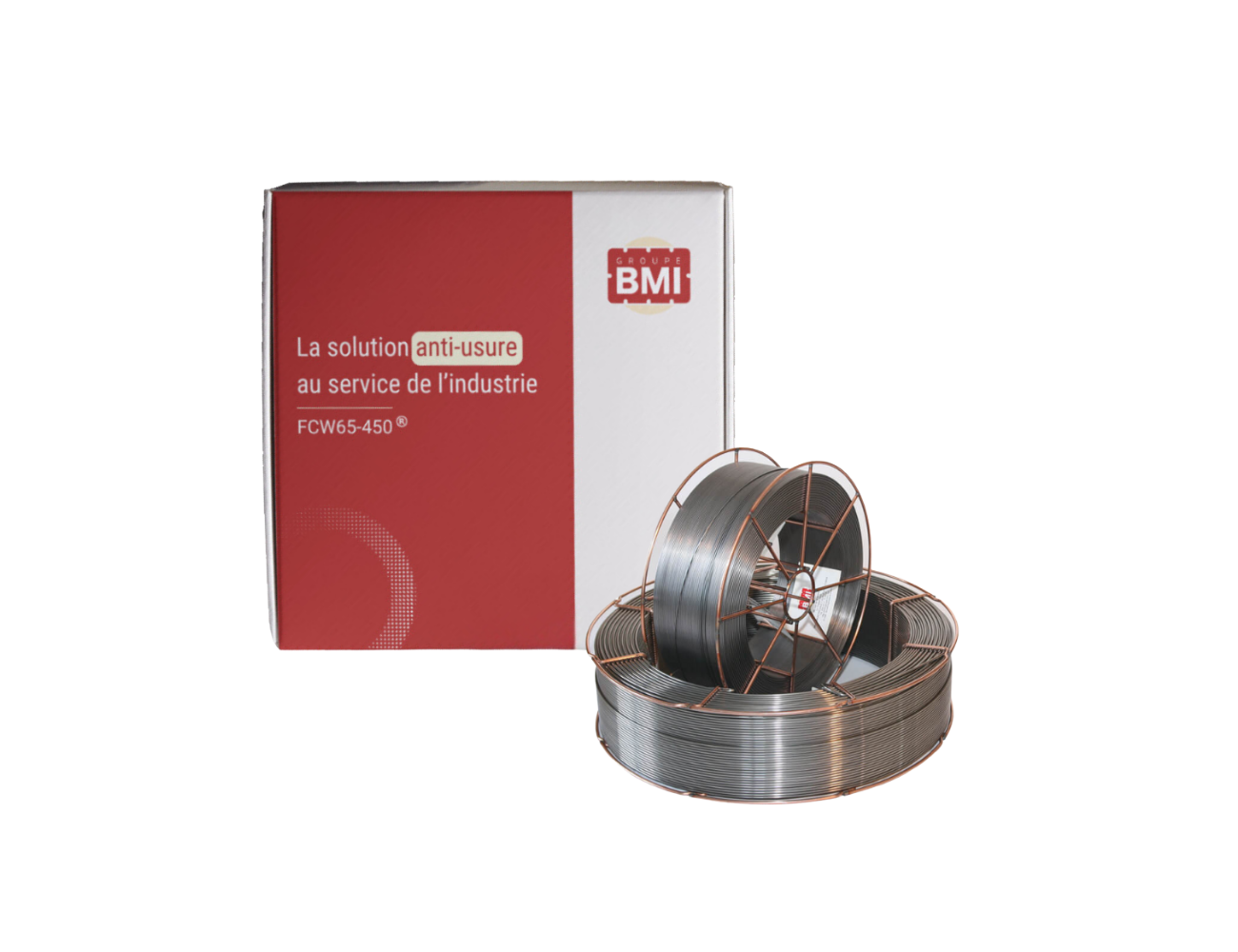
HARDFACING CORED WIRES
ADVANTAGES OF CORED WIRES
HIGH-PERFORMANCE HARDFACING
The tubular structure allows the integration of various alloying elements and carbides to obtain deposits tailored to specific wear constraints.
WIDE RANGE OF AVAILABLE ALLOYS
BMI offers a wide selection of hardfacing cored wires, allowing the deposit composition to be tailored to the constraints encountered in your process.
Our teams support you in selecting the most suitable wire to optimize wear protection and extend the service life of your equipment.
Different formulations cover a wide range of applications: abrasion, impact, friction, corrosion and temperature resistance.
HOMOGENEOUS AND CONTROLLED DEPOSIT
The controlled wire composition ensures a good distribution of carbides in the deposit, providing durable wear protection.
SOLUTION FOR MANUFACTURING AND REPAIR
Hardfacing cored wires allow the deposition of a metallic layer enriched with carbides to ensure long-lasting protection of components subjected to wear.
Thanks to controlled alloy formulations and tubular wire technology, they provide high flexibility and enable precise adaptation of the deposit to the wear mechanisms encountered: abrasion, impact, friction or high temperatures.
BMI offers a wide range of hardfacing cored wires for the manufacturing of new parts or the reconditioning of worn components.
the range
HARDNESS :
Type of wear :
Alloy with chromium, tungsten, niobium, molybdenum and boron providing extreme resistance to abrasion under high stress and moderate impact, suitable for temperatures up to 750 °C.
hardness :
66-70 HRC
Deposition of a highly work-hardening austenitic stainless alloy, providing excellent resistance to impact and heavy loads.
hardness :
As-delivered condition: 20–25 HRC
After work hardening: 45–55 HRC
Ideal balance between ductility and wear resistance thanks to a deposited metal based on tungsten carbides in a hard and tough matrix, providing excellent wetting.
hardness :
Ni Cr B Si matrix: ~500–600 HV
Tungsten carbides: ~2300 HV
Hardness: 45–55 HRC
Deposited metal with a martensitic matrix enriched with hard carbides, ensuring an excellent balance between abrasion, friction wear and impact, with performance maintained up to 500 °C.
hardness :
1st layer: ~57 HRC
Multi-layer: ~62 HRC
Extra hardfacing intended for components exposed to gouging wear, erosion and heavy impact.
hardness :
1st layer : 55–56 HRC
2nd layer : 57 HRC
Deposited metal with a martensitic matrix reinforced by hard carbides, ensuring an excellent balance between abrasion resistance, friction wear resistance and impact resistance, with performance maintained up to 450 °C.
hardness :
1st layer: ~550 HB
Multi-layer: ~600 HB
Deposition of chromium cast iron for hardfacing components subjected to severe abrasion with moderate impact, effective up to 650 °C.
hardness :
1st layer: ~58 HRC
2nd layer: 60–63 HRC
Extra hardfacing for components exposed to extremely severe abrasion with moderate impact, effective up to 450 °C.
hardness :
1st layer: ~58 HRC
2nd layer: 60–64 HRC
Deposition of chromium cast iron, enriched with chromium carbides in an austenitic matrix, ideal for hardfacing components exposed to severe abrasion with moderate impact.
hardness :
1st layer: ~58 HRC
2nd layer: 60–63 HRC
Deposition of over-alloyed chromium cast iron, enriched with hard primary carbides in a tough austenitic matrix, providing excellent abrasion resistance and moderate impact resistance.
hardness :
1st layer: ~60 HRC
2nd layer: 63–65 HRC